
10 games for kids, adults and an 80-year-old at one table
Ten games a 7-year-old, you, your husband and an 80-year-old can play together, with ages, round times and what to adjust.

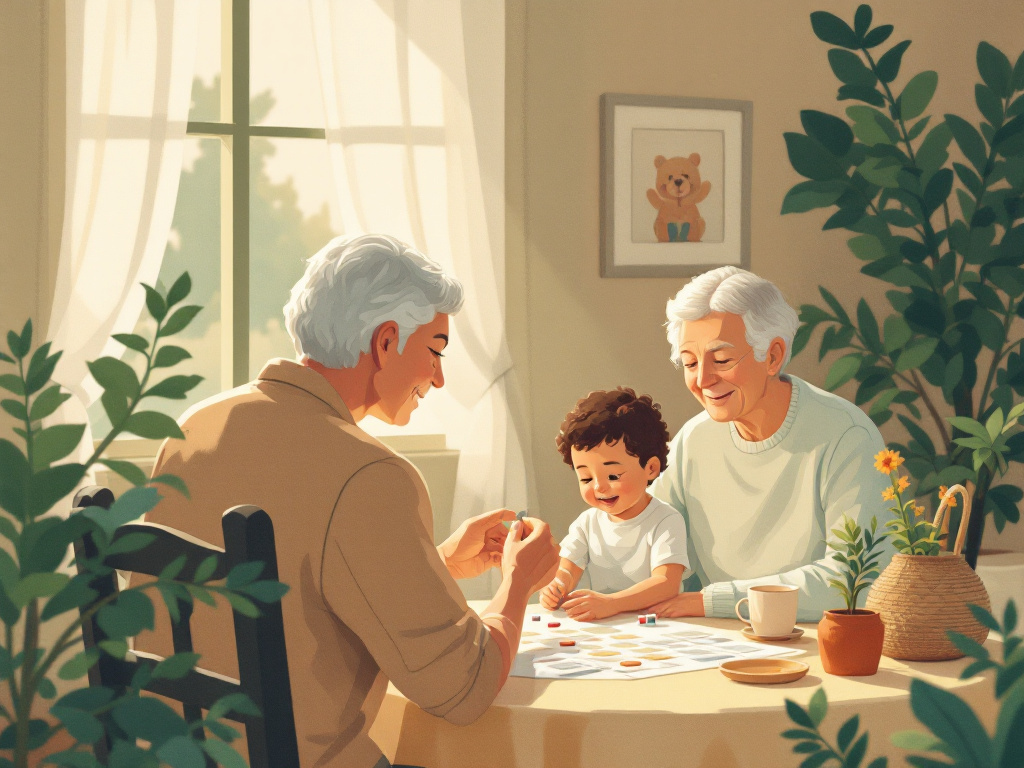
CasaLore / fal.ai (Flux 1.1 Pro)
This list is for the parent hosting a mixed table: one or more kids, your husband and your 80-year-old dad. Most of the ten games need only a setup tweak. Two need a workaround: Checkers is played in two teams so a 7-year-old and Dad can share a side, and Bingo uses cards you print yourself. Before the day, ask Dad to pick two games from the list and let your child pick one. Ages and round times throughout are editorial estimates, not publisher figures, so check the box for any game you buy.
What makes a game work for three generations
Four tests sort the good fits from the frustrating ones:
- A 7-year-old can learn it in a couple of minutes.
- Luck matters enough that the youngest can beat the oldest.
- It doesn't need fast hands, tiny print or shouting across the table.
- A round ends in about 20 minutes, or the game can pause without anyone losing their place.
The room matters too. Loud social settings can be frustrating for someone with hearing loss, and some people start avoiding gatherings because of it. If your dad has trouble hearing, pick a quiet room and keep to one person talking at a time.
Quick games (about 10 to 20 minutes)
1. Go Fish (ages 4 and up, about 10 minutes)
The rules take one minute to explain. Ask players to say card names out loud and clearly, and hand out card holders so nobody has to grip a full hand. Large-print playing cards and board games are sold for people with low vision, so if your dad squints at standard cards, swap in a large-print deck.
2. Crazy Eights (ages 6 and up, about 15 minutes)
Players match the suit or number of the top card. Luck evens things out. Run through the rules once with your child before Dad sits down, hand out card holders, and say each played card aloud.
3. Memory match (ages 4 and up, about 10 minutes)
Lay cards face down and take turns turning over two to find pairs. Children can hold their own at this one. Buy a set with big cards and clear pictures, or make pairs from index cards and a thick marker. Start with eight pairs so the first round stays short, then add more.
4. Uno (ages 7 and up, about 15 to 20 minutes)
Players match the color or number of the top card. Before you deal, say the house rules out loud: no stacking, and fewer cards than the box says if the game is dragging. Read the color aloud each time someone plays a wild card.
Longer games for a holiday afternoon
5. Checkers in two teams (ages 6 and up, 20 to 30 minutes)
Checkers has two sides, so make it a four-person game. Put your 7-year-old with your dad on one team and you with your husband on the other. Each team agrees on a move before anyone touches a piece, and teams alternate turns. The talking keeps the child thinking and gives your dad time to see the board. Seat everyone close to it.
6. Dominoes, such as Mexican train (ages 6 and up, 30 to 45 minutes)
Players match numbers and build a chain. Buy a jumbo set with large dots before the day, because counting tiny ones is the usual sticking point. Build the chain in the middle of the table so everyone can see it.
7. Sorry! (ages 6 and up, 30 to 45 minutes)
Players race pieces around a board and can bump each other back to start, so luck decides most games. Put the board in the middle of the table, and let your child draw and read each card aloud so nobody has to lean across to see it.
Games for low vision or hearing loss
These three suit a table where one person can't see or hear everything easily.
8. Bingo (ages 5 and up, about 15 minutes)
Make your own cards so you control the size. Print them in a plain non-serif font, size 14 to 18, black on white paper, which has more contrast than black on red. One caller reads each number slowly, facing the table.
9. Charades (ages 5 and up, about 15 minutes)
Acting needs no hearing, and standing in good lighting and using gestures is advice for talking with someone who has hearing loss. Have the actor stand where light falls on their face, such as next to a lamp.
10. Pig, a dice game (ages 6 and up, about 10 minutes)
Roll one die and keep rolling to add up points for your turn. Stop to bank them, but a roll of 1 loses that turn's points. Agree on a target score before you start, such as 50 for a short game. Have one person write the running scores on a pad in thick black marker so nobody has to remember them.
The ten games at a glance
Here is each game checked against a mixed group: a 7-year-old, an adult and an 80-year-old grandparent.
| Game | Ages (estimate) | 7-year-old plays? | What might need adjusting | Round (estimate) |
|---|---|---|---|---|
| 1. Go Fish | 4+ | Yes | Card holders; large-print deck | 10 min |
| 2. Crazy Eights | 6+ | Yes, after a rules run-through | Card holders; large-print deck | 15 min |
| 3. Memory match | 4+ | Yes | Bigger cards with clear pictures | 10 min |
| 4. Uno | 7+ | Yes, with light house rules | Reading colors aloud | 15–20 min |
| 5. Checkers in teams | 6+ | Yes, on a team with an adult | Seating close to the board | 20–30 min |
| 6. Dominoes | 6+ | Yes | Jumbo set with large dots | 30–45 min |
| 7. Sorry! | 6+ | Yes | Board in the middle; cards read aloud | 30–45 min |
| 8. Bingo | 5+ | Yes | Large-print homemade cards; slow, clear calls | 15 min |
| 9. Charades | 5+ | Yes | Good light on the actor | 15 min |
| 10. Pig | 6+ | Yes | Scores written large | 10 min |
Ages and round times are editorial estimates. The adjustments column is a set of suggestions, and your dad may need none of them. The large-print, lighting and quiet-room ideas draw on the guidance linked above.
An illustrative example: a mother, her husband, their 7-year-old and her 80-year-old dad sit down to play. They open with Memory match, because a quick first round gives the 7-year-old a real chance to win. Dad picks dominoes as the long game, so the host buys a set with large dots the day before. They close with Charades, once everyone is tired of holding cards.
If you have more than one child, pair a younger one with a parent as a team in any card game, and give an older child a job: caller in Bingo, scorekeeper in Pig or dealer in Uno.
If it's just you, your child and Dad, games 1 to 4 all play fine with three people. If Dad lives far away, Bingo can work over video: send him the card ahead of time and read the numbers slowly.
How to use this list
Pick one quick game and one longer game, and give each person a job before you start: dealer, caller or scorekeeper. Today, text Dad two or three titles from the list and ask which two he'd pick. For more activities he can lead, see easy things grandkids and grandparents can do together. If you want conversation at the table too, Thanksgiving question cards give everyone something to ask him, and the family trivia quiz lets him tell his own stories.
Sources used for this list
- Hearing Loss: A Common Problem for Older Adults · National Institute on Aging (National Institutes of Health) · checked Oct 26, 2026Primary source
- 10 Beneficial (and Fun!) Activities for Seniors with Hearing Loss · National Council on Aging · checked Oct 26, 2026
- Helping Adults with Vision Loss Stay Engaged and Connected · National Council on Aging · checked Oct 26, 2026
- Making Your Programs More Accessible for Older Adults with Vision Loss · National Council on Aging · checked Oct 26, 2026
Spotted a mistake or a source we should look at? Tell us.
What to do next

Where to get help
- AARP family caregiving · AARP
A caregiving phone line plus online and Facebook communities. You don't need to be a member.
- National Family Caregivers Month · Caregiver Action Network
November's national campaign for family caregivers.