
How to get your parent and kids talking at Thanksgiving
Thirty question cards, a ten-minute format for after the meal and a simple sheet for saving the answers, so your parent and your kids actually talk at Thanksgiving.

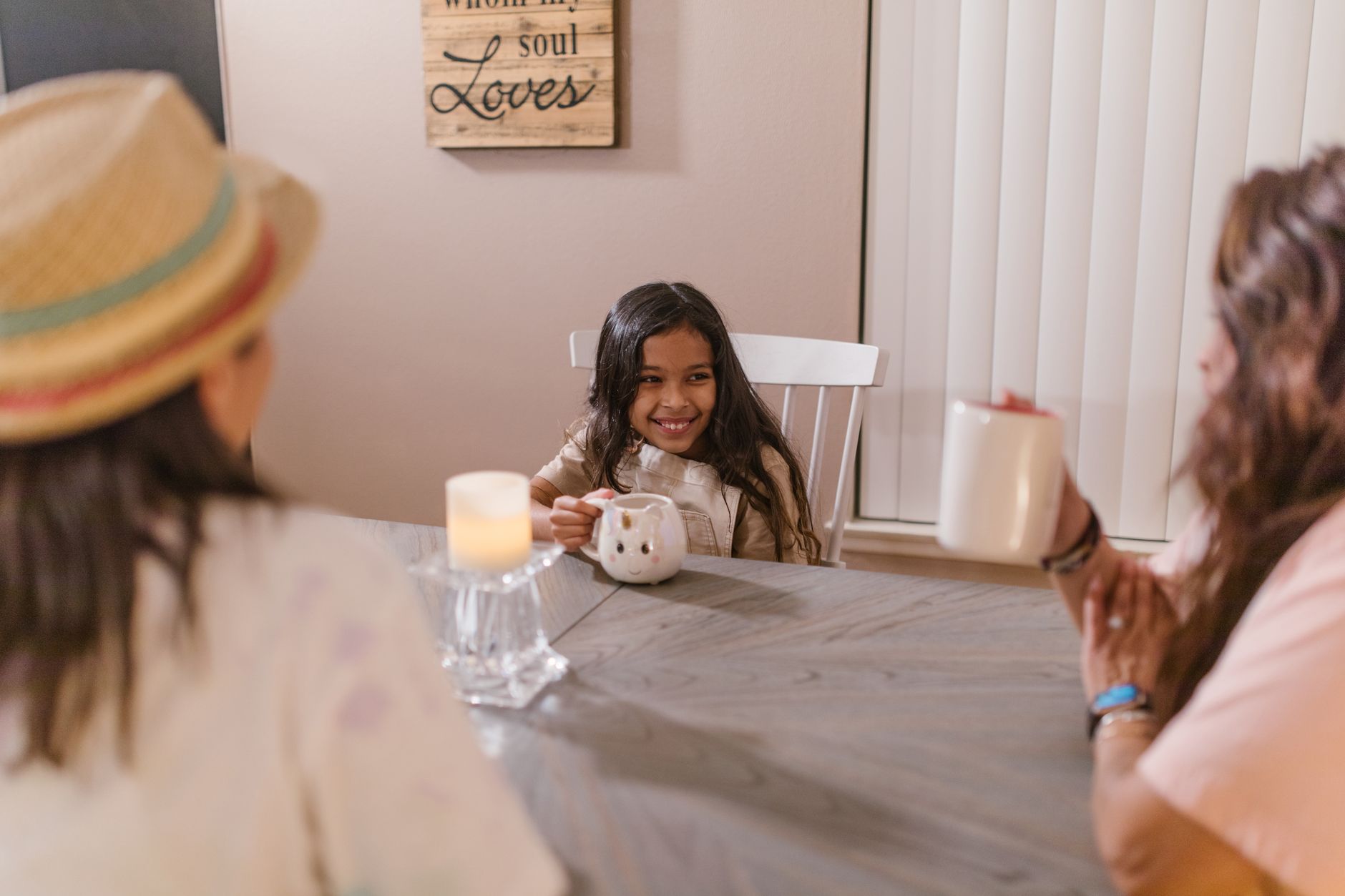
Photo: RDNE Stock project / Pexels
Why a little structure helps
Print or hand-write a small stack of question cards, set them on the table, and take ten minutes after the meal for everyone to draw one. That is the whole project. Below you will find thirty questions to copy, a ten-minute format, and a simple sheet for saving what you hear.
Structure helps because conversations across generations can be hard to start. People of different ages have lived through different times and may bring different assumptions and needs, and a lack of conversation topics has been reported as a source of anxiety, notes a research protocol on grandparent conversations.
A card takes the pressure off. Nobody has to think of a question. They only have to read one.
Choose a format: cards, a recording or a shared album
Pick one. Doing all three on the same afternoon is too much.
- Cards. Best for a busy table. Write each question on an index card or a strip of paper. No devices, no setup.
- Recording. Best if you want the voice. Use your phone's voice memo app and place it near the person answering. If a relative can't be at the table, StoryCorps Connect is a platform that allows remote recording of video interviews.
- Shared album. Best for a parent who talks more easily with something in hand. Ask each person to bring one old photo or object, and use the cards to ask about it.
If you're unsure, start with cards and a notebook. You can always add a recording next year.
If your parent won't be at the table this year, the cards still work over a video call: read the question aloud and let them answer from home.
Thirty gentle question starters
Copy these onto cards. Mark the first group "grandkids ask," the second "grandparents ask," and the third "for everyone." Most can be answered in a sentence, so a tired or quiet person can still take part. A few, like 10, 20 and 21, can open up longer or more emotional answers; leave them out if you want to keep it light.
Grandkids ask grandparents
- What was Thanksgiving like when you were my age?
- What was your favorite food as a kid?
- What was your first job?
- What did you do for fun when you were ten?
- What was the house you grew up in like?
- Who did you look up to when you were young?
- What was school like for you?
- What song or TV show did everybody know when you were a teenager?
- What is something you were really good at?
- What is one thing you'd like me to know about our family?
Grandparents ask grandkids
- What is the best part of your day at school?
- What are you really into right now?
- What is a game, show or song I should know about?
- What is something you're proud of this year?
- If you could eat one meal every day, what would it be?
- Who is your funniest friend, and why?
- What is something you'd like to learn?
- What would you change about Thanksgiving if you were in charge?
- What is a small thing that makes a bad day better?
- What would you like to ask me that you never have?
For everyone
- What is one thing you're thankful for that you'd never put on a list?
- What is a food that tastes like home?
- What is a family recipe worth saving?
- What is a smell that brings back a memory?
- What is the best trip you've ever taken?
- What is something someone in this family does that always makes you laugh?
- What is a tradition we should keep?
- What is a tradition we could start?
- What is a photo in this house you'd like to know the story behind?
- What would you like to be asked at next year's Thanksgiving?
Remove any card you think will land badly for your family. You know which topics are tender.
How to run ten minutes at the table
Pick a time when people are seated and fed, such as after plates are cleared and before dessert. If you want something for before dinner, try games like charades or Pictionary, where all ages can participate, as AARP's Thanksgiving games ideas suggest.
Minute 0–1: set it up. Whoever is hosting says something like: "We're going to do something short. Everyone draws one card, answers it, and that's it. You can pass any time." Put a notebook and pen next to one person who will be the note-taker.
Minutes 1–8: draw and answer. Go around the table. Let your parent choose whether to go first or last. Each person reads a card aloud and answers it, or hands it to someone else to answer. One follow-up question is enough, such as "What do you remember most about that?" At a big table, one option is two smaller circles with a card stack each. If it's just you, your parent and one child, take turns until the ten minutes are up.
Minutes 8–10: close. Ask the note-taker to read back a favorite answer. Thank everyone. Stop there, even if the conversation is going well. People can carry on over dessert, and a short round is easier to repeat next year.
If your parent tires easily, seat them where they can see everyone, let the grandkids do the reading and writing, and keep the parent's part to answering.
The card round is a small joint activity you can do face to face. Joint activities and face-to-face communication are essential to developing and keeping positive grandparent–grandchild relationships, according to a paper on grandparent–grandchild communication.
Saving and sharing what you gather
Use one simple sheet per person. Copy this into a notebook or a shared note:
- Date and place:
- Who answered:
- Question:
- Answer, in a sentence or two (their words if you can):
- Photo, object or recipe mentioned:
- Something to ask next time:
Within a day or two, take a photo of the page, or type it up, and send it to the family. Ask your parent first before sharing anything beyond close family. Showing people what you wrote down lets them correct or approve it.
If you want to turn this into something bigger later, technology can help you build a multimedia document of your family's story, as AARP's oral family history guide explains.
If your parent would rather not
Some parents don't like being put on the spot, and some topics are off limits. Be OK if they decline. If they won't let you record them, jot down as much as you can recall hearing, as soon after you hear it as possible. And recognize that there may be some things they never want to talk about. Those three tips come from the U.S. Department of Veterans Affairs' advice on saving veterans' stories, and they suit any family.
Try these gentler options:
- Flip it. Let the grandkids answer the cards while your parent just listens and reacts.
- Use a photo. Put one old photo on the table and ask, "Does anyone know who this is?"
- Make it optional. Leave the cards on the table without announcing a game. Someone may pick one up.
- Try another day. A quieter visit may suit your parent better than a holiday.
For more low-pressure ideas, see these easy activities for grandkids and grandparents.
If you're still planning the day, a four-week Thanksgiving hosting plan can help you find a calm spot for the ten minutes.
Your next step: choose ten questions from the list above and write them on cards this week.
Sources used for this guide
- Save our stories! Capturing the history, tales of America's Veterans · U.S. Department of Veterans Affairs (VA News) · checked Oct 13, 2026
- Effects of Sharing Old Pictures With Grandchildren on Intergenerational Relationships: Protocol for a Randomized Controlled Trial · JMIR Research Protocols, via PubMed Central (NIH/NLM) · checked Oct 13, 2026
- Digital media in intergenerational communication: Status quo and future scenarios for the grandparent–grandchild relationship · Universal Access in the Information Society, via PubMed Central (NIH/NLM) · checked Oct 13, 2026
- How to Create an Oral Family History · AARP · checked Oct 13, 2026
- StoryCorps Introduces New Way to Help Friends, Family Tell Their Tales Remotely · AARP · checked Oct 13, 2026
- How to Make Thanksgiving More Fun for Everyone · AARP · checked Oct 13, 2026
Spotted a mistake or a source we should look at? Tell us.
What to do next

Where to get help
- AARP family caregiving · AARP
A caregiving phone line plus online and Facebook communities. You don't need to be a member.
- National Family Caregivers Month · Caregiver Action Network
November's national campaign for family caregivers.